
What Is Radical Acceptance? Why Fighting Reality Often Makes Things Harder
Updated: Sep 6
Most of us have experienced a time when life took a direction we never expected. A relationship ends, someone we love becomes ill or dies, a career changes unexpectedly, or we find ourselves facing circumstances that we would never have chosen. Sometimes the difficult experience is something that happens to us, and sometimes it involves watching someone we love struggle and realizing that, despite how much we want to help, we cannot fix everything for them.
When life changes suddenly or painfully, it is natural to want things to go back to the way they were. We may spend a lot of time replaying what happened, wondering how things could have turned out differently, or wishing we could somehow return to the life we had before. There is often a period where the reality of the situation doesn't quite match what we had imagined for ourselves, and that gap can be incredibly difficult to sit with.
This is where the idea of radical acceptance can be helpful. It is not about liking what has happened or trying to convince yourself that something painful is okay. It is about gradually acknowledging the reality of a situation so that you are no longer using all of your energy fighting against the fact that it exists.
What Is Radical Acceptance?
Radical acceptance is the practice of recognizing reality as it is in the present moment, even when that reality is painful, unfair, or very different from what we wanted.
The word acceptance can sometimes be confusing because it sounds as though we are being asked to approve of something or give up on trying to change it. That isn't what radical acceptance means. You can accept that something has happened and still be angry about it. You can accept that a relationship has ended and still feel heartbroken. You can accept that you are in a difficult situation while continuing to look for ways to change what is within your control.
What acceptance asks of us is something slightly different: to stop arguing with the fact that something is already true.
This is often particularly difficult when we are dealing with grief, illness, divorce, relationship loss, betrayal, parenting challenges, or significant life changes. These are situations that can leave us feeling powerless, and the instinct to resist them makes sense. We want to undo what happened, find a different outcome, or return to the point before everything changed. Unfortunately, there are times when no amount of wishing or fighting can bring us back to where we were.
When Fighting Reality Adds to the Pain
There is, of course, the pain of the situation itself. If you lose someone you love, experience the end of an important relationship, receive a difficult diagnosis, or go through a major life change, that pain is real. Radical acceptance does not make it disappear.
What can make an already difficult situation even harder is the ongoing struggle against the reality of it. Thoughts such as This shouldn't be happening, It's not fair, or I just want things to go back to the way they were are completely understandable. Most of us have those thoughts when something painful happens.
The problem is not having those thoughts. The problem is when we become so caught up in the fight against reality that we have very little energy left to deal with the reality we are actually living.
In that sense, we can end up carrying two things at once: the pain of what happened and the exhausting effort of trying to make it unhappen. Radical acceptance doesn't remove the first part, but it can help with the second.
The Riptide Metaphor
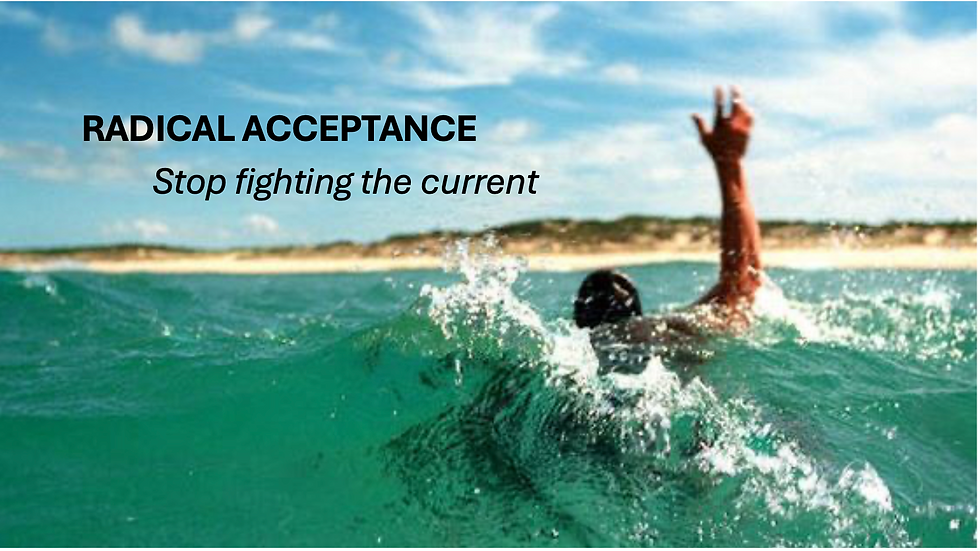
One way I think about radical acceptance is through the image of being caught in a riptide.
Imagine that you are swimming in the ocean and suddenly realize that a strong current is pulling you away from shore. Your instinct might be to panic and swim as hard as you can toward the beach. You want to get back to where you started, and it makes sense that your first reaction would be to fight the current.
The difficulty is that swimming directly against a strong current can quickly exhaust you. The more frightened you become, the harder you may fight, and eventually you can find yourself using all of your energy simply trying to force the ocean to do something different.
At some point, the first thing you need to do is recognize what is happening. You are in a current.
That recognition doesn't mean you like it or that you somehow chose to be there. It doesn't mean the situation is fair. It simply means you are seeing the situation clearly enough to respond to it.
Once you recognize that you are in a current, you can stop spending all of your energy trying to get immediately back to the exact place where you started. You can conserve your energy, think more clearly, and focus on what you need to do next. Depending on the situation, that might mean seeking help, waiting for the intensity to pass, or finding a different way forward.
Eventually, the current changes. You may need to move parallel to the shore before you can make your way back, and you may find yourself coming ashore somewhere different from where you began. But the fact that you are no longer in the same place does not mean you haven't found your footing again.
I think this is one of the reasons the metaphor works so well when we are talking about difficult experiences in life. When something significant happens to us, there is often a strong desire to get back to who we were before it happened. We want our old life, our old relationship, our previous sense of security, or the future we thought we were going to have.
Sometimes, though, we can't go back in quite the same way.
Over time, the intensity of the experience may soften. We begin to find our footing again and learn how to live with what has happened. That doesn't mean the experience didn't matter, and it doesn't mean that we are grateful for every difficult thing we go through. It simply means that the experience becomes part of our story, and we eventually begin figuring out what life looks like on the other side of it.
We may have lost things along the way. We may also have learned things about ourselves, developed strengths we didn't know we had, or gained a different perspective. Usually, it is some complicated combination of all of those things.
Acceptance Is Not the Same as Agreement
This is an important distinction because people often worry that acceptance means giving in.
You can accept that something happened and still believe it was wrong. You can accept that someone is not going to change while deciding that you no longer want a relationship with them. You can accept your current circumstances while continuing to take steps toward changing them.
Acceptance is not passivity. In many situations, it is actually what allows us to see more clearly what needs to happen next.
When we are spending all of our energy wishing something were different, it can be difficult to make decisions about what is actually within our control. Once we acknowledge where we are, even if we don't like it, we can begin to consider our options.
Sometimes acceptance sounds as simple as: I don't like this. I wish things were different. But this is where I am right now. That may not feel particularly inspiring, but it can be an honest place to start.
Radical acceptance also connects closely with the principles of Acceptance and Commitment Therapy (ACT), which focuses on making space for difficult thoughts and feelings while continuing to take steps toward the things that matter to us. You can read more about ACT in our article, Embrace Life Fully: How ACT Therapy Can Transform Your Mindset and Well-Being.
Practicing Radical Acceptance
Radical acceptance is not usually something that happens all at once. It is often a process that we return to repeatedly, particularly when we are dealing with something painful or outside of our control.
It can begin with noticing the moments when you are arguing with reality. You might notice yourself replaying what happened, wishing someone would change, or spending a great deal of energy focused on an outcome that you cannot control. From there, it can be helpful to gently ask yourself what is actually true about the situation and what part of it is within your ability to influence.
This doesn't mean forcing yourself to feel okay about something that isn't okay. In fact, acceptance often involves being more honest about how difficult something is. You can acknowledge that you are angry, grieving, disappointed, or frightened while also recognizing that these feelings are a response to something that is happening in your life right now.
For some people, it can help to distinguish between the things they can influence and the things they cannot. There may still be decisions to make, conversations to have, boundaries to set, or changes to work toward. Acceptance is not about doing nothing. It is about putting your energy into the parts of the situation where your actions can actually make a difference.
What Radical Acceptance Can Look Like in Everyday Life
Radical acceptance can show up in many different ways. It might involve accepting that you cannot control how another person feels about you or whether they understand your perspective. It might mean accepting that your teenager is going to make some mistakes despite your best efforts to protect them, or recognizing that a relationship is not going to become what you hoped it would be.
It can also be helpful when we are dealing with anxiety. Many people understandably spend a great deal of energy trying to get rid of anxious thoughts and feelings as quickly as possible. Unfortunately, the harder we fight certain internal experiences, the more attention they can sometimes demand.
Acceptance doesn't mean wanting anxiety to stay or deciding that there is nothing you can do to manage it. It may simply mean recognizing, I'm feeling anxious right now, without immediately beginning a second struggle about the fact that anxiety is present.
From there, we can focus on what might actually be helpful. We can ask what we need, what is within our control today, and what support might help us through the situation. Those questions may not provide an easy solution, but they can move us away from the exhausting cycle of trying to make reality disappear.
Acceptance Takes Time
There are some things in life that take a long time to accept. Grief is one example. You may understand intellectually that someone has died and still find yourself expecting them to walk through the door or wanting to call them. You may know that a relationship has ended and still wake up wishing that things had gone differently.
Our emotional understanding doesn't always catch up at the same pace as our intellectual understanding.
Acceptance is often something that happens gradually. There may be days when you feel more settled with the reality of a situation and other days when the anger, sadness, or disbelief returns. That doesn't mean you are going backwards or failing at acceptance. It is often simply part of processing something significant.
Over time, the struggle may become less about trying to get back to exactly where you were and more about understanding where you are now and what you need as you move forward.
Life Keeps Changing
One of the difficult things about life is that nothing stays exactly the same. The circumstances we are living in now will change, and so will we.
That doesn't mean every difficult chapter has a lesson or that everything happens for a reason. Sometimes painful things happen, and we don't need to find a silver lining in them.
Radical acceptance simply gives us another way of responding when life doesn't go according to plan. Rather than spending all of our energy trying to return to a version of life that no longer exists, we can slowly begin to respond to the reality in front of us.
There is often grief in that process. There can also be uncertainty, anger, and fear. But eventually, there may be enough space to begin thinking about what comes next.
In counselling, radical acceptance can be helpful for people navigating grief, anxiety, relationship challenges, health concerns, parenting difficulties, and major life transitions. It is not about saying that something is okay when it isn't. It is about acknowledging what is true so that you can begin deciding how you want to respond.
Sometimes that is the place where things begin to shift; not because the difficult situation has disappeared, but because you are no longer spending quite as much energy fighting against the fact that it exists.
If you'd like to explore this topic further, you may also find helpful resources in our Trauma, Stress & Wellbeing blog collection: Trauma, Stress & Wellbeing Articles
__________________________________________________________________________________
Advance Counselling offers in-person counselling and walk-and-talk counselling in North Vancouver, as well as secure online counselling across British Columbia, Manitoba, Saskatchewan, Yukon, and the Northwest Territories.
This article was written by Ashleigh Gold, MA, RCC, co-owner of Advance Counselling. Ashleigh and co-owner Natasha Chalke provide compassionate, evidence-based counselling for couples, adults, teens, and families navigating anxiety, ADHD, trauma, relationship challenges, parenting, co-parenting, and life transitions.


Comments